A visualisation of the holographic principles of real and imaginary worlds, illustrated in harmonic perspective, with a wave-particle “toy” universe in the companion website.
This book is a playful/serious art-science map of modern physical cosmology, drawn from first principles and in accessible language, with a focus on the surprisingly familiar visual and even musical aspects of the theory. Combining aesthetics and harmonics with mechanics, relativity and basic neuroscience, ultimately the universe of quantum gravity is pictured without space or time by sensory illusions of depth – perspective, harmony and balance, essentially – that are as much physical continuity laws as artistic viewpoint guides for immersion and movement. The aim of this usefully visible idea is to see and hear (or imagine so) the open edge and pinnacle of science, the Holographic Principle, as the visually intuitive, symphonic concept of a horizon.
To identify a skyline with the relative end of time is no less familiar. Horizons contain cosmological spaces that evolve harmonically into a range of closed and open futures. There is a converging limit of many possible frames, with an indefinite endpoint: we can be doomed, and not. The total is a range of probabilities, some ending in complete destruction. The solutions of these principles are explored in a ‘toy universe’ model developed in visual mathematics and presented in open software.
The point is to revisit these abstract, dangerous concepts in a naturally accessible way. But perspective has powerful moving parts, in particular where the lines of sight correspond to holographic concepts in neuroscience, quantum mechanics and cosmology. This may be the largest horizon, the union of these advanced theories in a mirage. Hope, made realistic by evidence, is of general importance to public discourse. This book seeks to play the universe in terms that anyone can follow and enjoy.
***
Physical Perspective Geometry
It is not a new idea that visual and musical geometries reflect physical reality. Since prehistory we have known sight-distance and force-distance laws, first in stone and wood, then music and fire, the spear and the wheel, in art and science down the ages. What’s new is the emerging technical consensus on a holographic horizon, producing a physical illusion at the edge of time. Since physics is geometry, you can imagine this in a perspective view. Diminishing, foreshortening and eclipsing effects on force and equilibrium, tools and technology in other words, are equivalent to shapes and profiles in view and sounds in volume and pitch. Likewise gravitational curvatures and particle probabilities diminish and foreshorten as though seen/heard at those distances and oblique angles, using hardened mathematical tools that work like visual and aural survey.
For example, relativistic gravity can be imagined by the profile area of a planet or star eclipsing the background as you approach from deep space: tides and curvatures increase in proportion to its visible or even audible size. Likewise polarized and spin-oriented particles project shadows of their amplitudes into a measurement, following rules like a bat and ball to a child’s eyes, in states of probability that diminish over distance. Objects both real and imaginary appear larger and more dilated the nearer they are seen by an observer, in the same way that physical effects dilate and disorient into horizons, as a landscape swells, rotates and bends as you move through it.
This is as close to artistic and musical ideals as a theory can safely approach. Science is a form of creative insight, a sensation and realisation of Cézanne as much as Einstein. Here the paradoxical, beautiful, dangerous concepts of particle mechanics and deep-space gravity, falling outwards to the eclipsing horizons and entangled reactions of a subatomic multiverse, ultimately snowball to collapse in decay at the edge of existence. So it’s not all bad news. Across a landscape of lyrical continuities, this parallel reality (or the thought of it) is almost all you need to fathom the depth: a moving boundary of time in real and imaginary numbers like rays of starlight in every direction.
The solutions of these principles are explored in a ‘toy universe’ model developed in visual mathematics and presented in open software. It’s a toy in the sense that you can play with it, the big picture of an evolving polar model of spacetime in expanding shockwaves at lightspeed, with a thin film of evanescent galaxies and wave-particles at illusory distances and depths in time. You can surf and modify the simple or advanced model at your own level in the software or the maths, the companion website or the book. In one phase the model depicts intergalactic motion, a burst of particles as a mode of travelling, returning to the roots of physics: technology, and the things we need to do to survive. The total is a range of probabilities, some ending in complete destruction.
In the stress-momentum of an attacking moa we might once have sensed the reality of physics at a distance. So if you’ve felt the vertigo of infinity and wondered what it meant; or if you’re struggling with science right now and could use some perceptive imagery in plain language; or you’ve read the entire popular physics literature and are a bit jaded at our failure to convey the most abstract ideas at the coalface; or indeed if you’re a curious artist, eclectic musician, philosophically inclined poet and/or a pleasantly relaxed physicist or neuroscientist, then this book is for you.
***
Outline of Contents
Preface
Visualising Physics: a dangerous science re-imagined in the harmonic illusions of space and time.
Chapter 1: Vanishing Points and Particle Physics
A brief history of physics and technology in visual and aural terms. Stone tools depend on the spatial-visual concepts of foreshortening and diminishment, which relate to visual and musical art forms as geometries aligned with harmony. These continuity laws of physics are essential factors in practical technology and art, the material and cultural basis of civilisation from the Pyramids to the Greek atom to quantum mechanics. Matching continuity with visual perspective and its harmonic waveform, the modern atomic descendants are uncertainties and exclusions in wave-particle-field theory, built on mythic and modern Action Principles, to Bayesian probability and entanglement with indications of quantum gravity.
Chapter 2: The Spacetime Illusions of Light and Gravity
Continues the history in the second main branch of physics, relativity – or perspective in motion – from Galileo to Newton to Einstein and the recent giant steps of quantum gravity. Collates the longer historical debate on the nature of time, and by its natural equivalence, space. Reverses time to understand antimatter, partially linking relativity with quantum theories. Continues collating spatial evidence for perspective-continuity interpretations of harmonic energy and matter mechanics, with powerful holographic edges to the experience of falling and hence the curvatures of spacetime geometry. Loops back to quantum gravity and gravitational entanglement.
Chapter 3: Mind, Language and Paradox
Follows the evidence for actions of the mind in a decision process leading to the development of science via creativity. Takes the view that reality is both mind and nature, our perceptions mediated by senses into the open environment of a holographic neurophysical system that remains unexplained in modern science and all of philosophy. Follows the entanglement-mediated collapse and persistence of wave functions as a gravity mechanism of quantum intelligence. Reflects on the nature of a universe dominated by holograms at key horizons, singularities and in our own minds, without falling for the social error of solipsism.
Chapter 4: The Here-and-Now Quantum Cosmos
Chapter 5: A Clockwork Hologram
Chapter 6: The Serene and Eternal Multiverse
This indefinite universe is a kind of music eclipsed by itself, a first effect of perspective. Life and complexity arise from physical principles that defy conception but are nevertheless visible and accessible to experience. A multiverse has all possible outcomes, from a riptide of destruction to eternally evolving higher entropy states that may in time bring forth every possible form of life. Admittedly most of the alternatives lead to destruction, but there is at least one harmonic endgame where the event horizon is always exactly twice the present age. We may remain in a universe half-full, so we need not worry.
Acknowledgements, Further Reading and Journal References
***
About the Topic, and the Author
Science history is only approximately linear. At any point of discovery we’re always referring forward to where past discoveries now lead us, and back to earlier time to see how the idea arrived after other discoveries. It’s even possible to tell science history in reverse, and still make as much sense as your actual understanding of some of the ideas. The challenge is to get the concepts in the right order, so that this strange tower of unfamiliar language stands up in your head.
Physics, the first and most dangerous of all sciences, has very old roots. Beginning with a stone-age tool maker at the dawn of technology, and considering the very human techniques that coordinate the hand to the eye, we follow the state of the art to a terrifying universal conclusion. Beyond the Earth’s tragedy, looking to the sky and drawing the story to a final view of the future, well-known parallels between the cosmic event horizon and a leading theoretical neuroscience produce all the natural effects of visual perspective in dual holograms of inner space. You can see it, in your mind or when you look at the stars. This humanist approach to art-science history and interpretation works well in the musical language and visual analytics that the subject naturally lends itself to.
By real and imaginary in the byline, I mean worlds that are physical ideals with complex number projections, wave-particles in field theory and eventually a full particle-field theory of gravity, and also the theories and mental actions that describe and recreate those worlds in calculations and predictions. The mind-brain and its reality should be considered to be as separate as a landscape and a map, yet both arise in the same physical systems that evolve a brain as not, and there is no easy place to make this distinction, nor will we ever really know. So imaginary is all mythology and scientific theory and the minds that carry them as a means of explaining what we see.
We live in a stunningly beautiful world that happens to have the same visual pattern as the underlying maths, presumably so we don’t have to work that hard. From your own relative point of view, figuring in the text and diagrams, you can see or imagine a physical cosmos and guess at how it fits the open environment of your brain. The most recent and bizarre idea of all, that we can theorise the relative end of time as a holographic image, in complete detail but still a mind-like illusion down to the subatomic state of our immediate self and local space, is an incredible challenge to normal ideas of ‘reality’. These concepts are now regarded as principles in their own right, which should sound a warning.
Fortunately the author is a scientific generalist and multimedia artist, a keen observer and good storyteller, and rarely an Australian symbolist of Welsh-Dutch descent. So you are in good hands.
This is a story by nature so rich with creative insight, it almost writes and reads itself.** You don’t need to do the mathematics of geometry, you can sense it all around you, and the laws of physics work just the same. The result is a compellingly human, richly illustrated and musical-lyrical visualisation of modern physics, from the subatomic to the cosmic, via the quantum intelligence of mind and the laws of perspective.
** Other than direct quotes referenced in a “Turing test” interview with ChatGPT, no AI tools or generated text were used in the writing of this book. No permissions, rights or copyright exceptions are given or in any way implied to third party actors for purposes of AI training or anything else.
***
The Journey
It’s a worthwhile exercise to look for traversable routes over a serious literary impasse that professional physicists themselves are first to admit: even they don’t really understand their science. Beyond the conventional idea of cognition, physicists engage with nature by internalising and then generalising the patterns in the data, leading them to indirect, partial experience of complex abstractions, imaginary geometries, which remain inaccessible at deep levels that you just have to get used to even if you give your life to it. Popular science it is not, or not anymore. Since the long-ago dawn of the twentieth century, physics has not made common sense.
Studying modern physics is not like learning a language to read a work of literature for meaning in the original. The natural language of physics remains only partly decipherable, a system of ancient and modern hieroglyphics that often remain literally imaginary even as you write them out in full. There is a certain logic to the continuity and sequencing of nature, the principles that guide physical derivations, but you are only permitted to follow the natural steps of mathematics in the abstract to arrive at results that must agree with experiments and/or observations, which themselves may have no particular meaning outside of those always-incomplete interpretations.
Should we conclude that the entire project of popular physics is impossible? Can we ever develop a casual public appreciation of the abstract ideas that underlie the apparent non-reality of the physical world? We may justifiably insist that there has to be some realistic context of experience, at least in the process of observation and experiment, and yet we struggle in any case when the resulting explanations go almost immediately to invisible or unavailable ideas.
How do we accurately picture the indefinably tiny electrons that supposedly explain why it’s hard to thread a needle, or the vast curvatures of spacetime that explain why the planets orbit the sun? The origins of physical knowledge are ideas that can be experienced, usually by constructing instruments that amplify some natural signal, but almost always the very next steps go beyond direct experience and become hard mathematics that won’t take us to understanding even if we know how to do that.
The question becomes, how can we retain the direct, native experience even as we penetrate the mathematics? The original fable of science is the experience of Archimedes, the Eureka moment when one of the world’s first and greatest scientists felt the weight of displaced water in a bathtub subtracting his own relaxed weight, and suddenly understood why some things float while others sink. That moment is a rare chance in a world where even the most obvious and visible forces are hard to understand: like, why do weights fall with the same acceleration regardless of weight? Why is lightning fatal in a wet kite-string but not a dry one? Why does a neutron star lose mass as it vibrates in orbit around another star? Is there a level of experience that can carry us through these explanations? Can we find some sensibility to explore the maths and make sense of the theory, to go further than merely deriving or worse, just memorising it?
The surest, and certainly fastest route to truth, suspect though that is, is to see it, at the speed of light, followed at some distance/time by semi-truths that you may have only heard, and at immediate distances by the very suspicious sensations that we merely feel, which tends to prove Archimedes’ genius. Apart from fluid mechanics then, where it’s better to float, swim or surf, the senses of sight and sound are the most direct route to experience in a world that is extended beyond ourselves, parallel to sensations of heat and weight that can be direct or indirect depending on whether you stand close to a hot engine or drive it at dangerously high speed. You can lift a heavy weight, or if not then you can tackle it with a lever or a pulley, by the same rules. In all of these sensory learnings, the rules of geometry bring out the mathematics that we need to conceive of an idea. Geometry is something we can see in almost everything we notice at a distance, with applications in sound, light, heat and weight as the main experiences of reality.
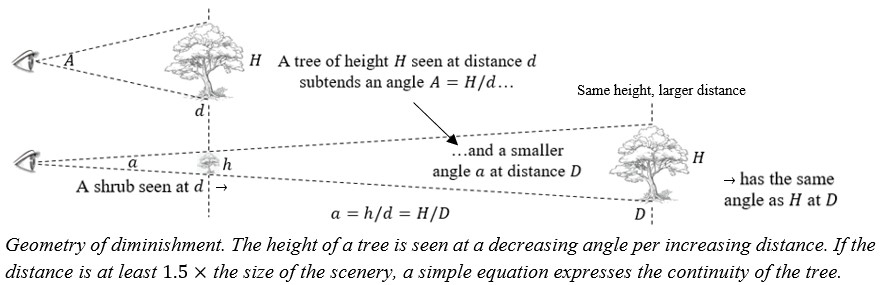
The central argument of The Vanishing Skylines of Quantum Cosmology is that we can see the laws of physics by their direct and mathematically exact correspondence to the rules of visual perspective. Similar effects apply to sound and gravity, which radiate at their own speeds, one of which happens also to be the speed of light. Light and sound each have a spectrum of colour and pitch, which turn out to be the effects of their wavelike properties. The waves, when we look closer, are tiny pieces of impactful wave effect that we thought were particles. All these effects are balanced around certain factors that do not change, making scientific prediction possible, in ways exactly like looking at objects and noticing their diminished and foreshortened shapes as their fixed actual shape appears with distance and angle, i.e. geometry.
All these effects derive from one of the most fundamental laws of physics, the Continuity Principle. Continuity is a makes-sense idea that turns out to be exact on a number of levels, the two main aspects being connectedness and compatibility. Things have to fit together in any setting, so if you have more of one thing, you must have less of another: to fit more balloons in a box, you have to squash the balloons down to fit them all in. The balloons won’t be compatible if they are not connected (adjacent in some sense) and continuous (full of gas), the combination being to produce forces that push back against you.
This recurring law has a simple equation that you experience directly when you pour water from a glass to another glass of different size or shape: the fixed volume of a given liquid changing shape, at its simplest, is just the base area times the height: aH = Ah = V.
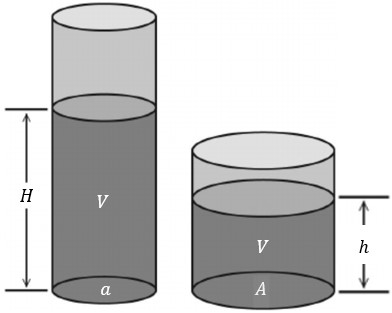
Simple Continuity, or How Things Fit Together: the same volume has any shape, at its simplest a depth on a base area. There is a point in childhood development when children recognise continuity and suddenly understand sharing.
For another example, if the volume of a container is flexible and the fluid is compressible, like a balloon with nearly constant temperature, when you squash the shape its pressure and volume vary in the same way: pV = Pv = kT (pressure increases as volume decreases at constant temperature). With the right logistic handling, the k is just another constant. This simple continuity equation applies to so many situations, it may well be the only physics equation you ever need to remember. It takes its name from the continuity of fluid flowing, which increases in velocity when it passes through a narrower area, that is vA = Va = Q (constant flowrate).
There’s nothing special about multiplying two numbers together. It becomes special when the resulting product is constant or conserved from one place or time or setting to another. It means you can predict how things will change, and what should remain, across a very wide range of experience. There are lots of ways you can formulate that, and this is the simplest. It is a deep place in mathematical physics, with hidden symmetries that unify many kinds of effects. Balancing changes by connecting the inputs around a fixed output is so powerful, its nearest analogy must be musical harmonies that repeat across many values, from basso profondo to soprano.
Things also have to fit together dynamically, in time, the main effect being that things happen smoothly and gradually, not suddenly or jumpily; spacecraft can’t just leap out of sight in a blink of the eye, or if they do seem to jump then there must be some deeper continuity to control it. One of the oldest physical laws, updated for very high velocities, is Newton’s relationship between force, mass and acceleration, F = ma; that is, for a given force, such as the maximum strength of a weightlifter, small masses accelerate faster than large ones. There is a natural symmetry mA = Ma for large and small combinations of measurements.
This controls the reaction rate of spacecraft at high velocities, and in fact the limiting speed of light guarantees that no instantaneous motion is possible, as it would violate the continuity principle. If things could happen instantaneously, everything would probably happen all at once, which would make a very poor story. Continuity is then a forecast of things to come, which in some ways can be expected, but in other ways should keep you on the edge of your seat.
For my argument, two cases with powerful continuity are in 1) the diminishment of perspective;
… and 2) the approach of gravity:
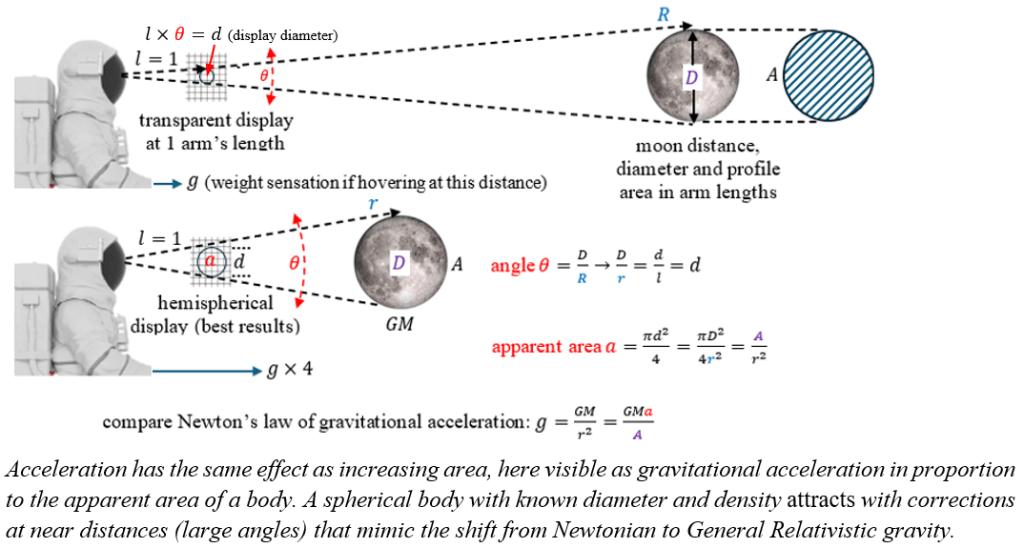
Visual comparisons, or the subjective momentary experience of observers restricted to observation from only one point of view, are aspects of physics that physicists are well aware of, but which they tend not to think about. There is a very good reason for this, namely that the abstractions of physics (such as continuity and all its effects) are more powerful as mathematical tools if you avoid visualising them. Excellent professional teachers go almost immediately beyond imagination by plunging into the abstract, so as to encourage abstract thinking in their students. There are occasional hand-waving analogies and thought experiments but these are often carried off as jokes, or are more about a particular style of genius than the substance of an idea. In the worst classes I have sat through, they won’t even provide a diagram.
The main problem for a non-pro readership is that without actually enroling and working hard to pass you may have only your own senses, conceptions and curiosity to go by, and probably don’t want to follow the argument too far into abstract. This book keeps the visual idea of the maths in mind as it gazes at the physics, ending in all finality at the real and literal horizon. We can see this in one form or another wherever we look, a powerfully exact model of the holographic edge and observable volume of our universe. It’s a viscerally mind-boggling abstraction at the leading edge of science and a new chapter in the genre of popular physics, because we can see it and experience it even as we work mathematically to understand it, an idea that is everywhere and at every depth in almost the whole of science.
…
One illustration should suffice for this short history. Ever since Isaac Newton sensed and realised gravity in or around 1666, we have failed to understand how that elusively obvious force reaches out and pulls us down without an agent or action to that reaction. This is despite Newton’s own slightly glib notion of action-at-a-distance, which are the four words he came to by boiling down the inconclusive argument. His critics protested in their own refined Royal Society way, but had to agree because of the stunning, era-making accuracy and universality of the theory.
Three hundred and sixty years later, we still largely fail without the maths to understand this. Albert Einstein’s explanation (in 1915) is that mass-energy and spacetime influence each other directly, not at a distance but wherever a particle of energy-mass sits against a soft curve of spacetime, moving and warping at that local point in an orbit. It’s a direct connection. That’s all well and good if you can follow the maths, but most of us are still asking, as of action-at-a-distance, well? How? Exactly how does a blob of mass reach out into logical references of speed and timing, as though a line of action is stretched out over a connective comparison of spacetime? We are assured that the solution is not to think of an elastic medium of any kind, but to derive expressions of the relativity principle.
Here is a way to picture it at least: a planet’s gravity increases as you approach, in the same way that its appearance in the sky increases in apparent area. That is, your tendency to fall towards a body, or your weight if you just hover above it, are in proportion to what you see. The solid angle eclipsed by a planet dilates as you get closer, and its gravity is larger in the same scale. That’s a visual effect, which you can see whether or not you understand it, but it’s also true and familiar enough that masses have direct effects on other masses, in collisions or interactions by proximity of any kind. If we accept the continuity of spacetime on mass-energy-momentum, the potential for these effects is expected to develop gradually, i.e. with continuity, not suddenly. The most natural way to do that is to increase along the same path as the planet’s approaching visual profile, since that is transmitted by light, and because gravitation transmits in a similar radiative light-speed way.
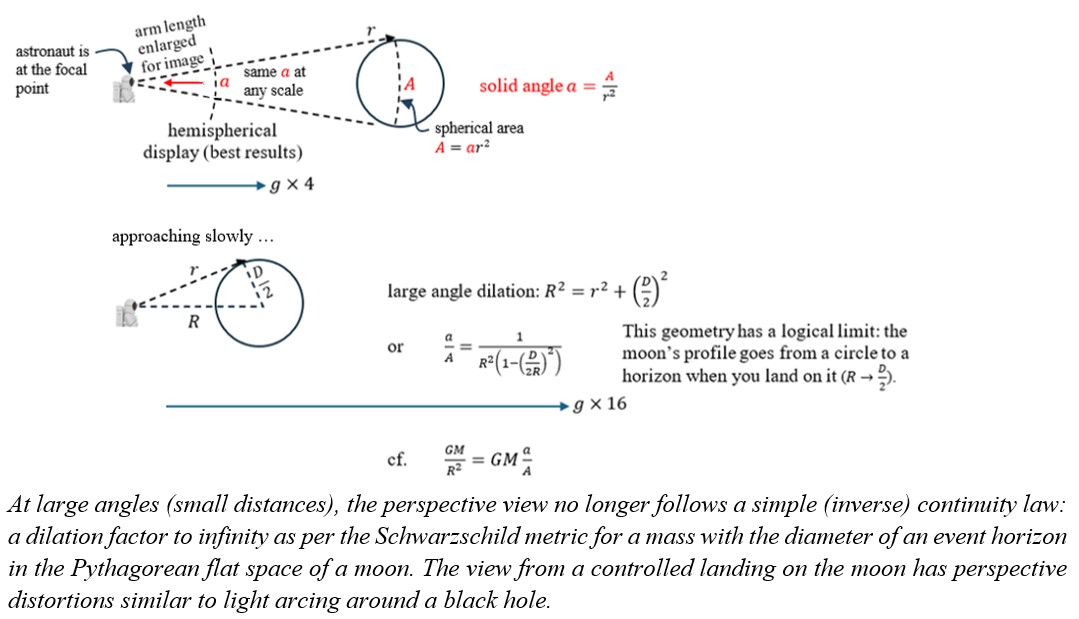
Newton himself noticed and mentioned the relation of his gravity law to physical perspective by area, because the square-law expressions of his theory are identical to the diminishment of light with distance and are ideal for making the conceptual step that physics resembles all you can see, but like any great physicist he made nothing of it, a mere visual distraction from the abstract.
What Newton didn’t know is that not only apparent space, but also time are diminished, both these physical effects being analogous to perspective via continuity. Time and its gradients have no meaning unless there is change. A gradient in spacetime is a movement, a velocity (metres per second) or an acceleration (in area of time, metres per second-squared). In the case of gravity, the change we see is movement with balance, not just falling but travelling in a combination that leads to an orbit, or with no balance a downward free-fall. The energy-momentum of the mass acts on a distance-diminishing profile of the spacetime-area, and vice versa, in the same way that one half of an action-reaction pair acts against the other.
Action-reactions are the means by which objects propel themselves, by swimming or pushing off the mud, by crashing in lightning or burning in fire, jumping or flying or rocketing or gravitating. Spacetime is not just empty or even active space, it is the whole context of action, so its curvatures support and push against mass-energy to produce movement. By following the action of a spacecraft descending we can draw the curve of a planet reacting outward to the encircling flat spacetime of a horizon, even the holographic information-event horizon of a black hole. It’s as though an Action goal of the universe is to relax towards the easiest geometries, coming together first as spherical volumes, then evolving still further as they move to lie as flat as possible against each other in a correspondingly flat spacetime, without waiting for opposites to attract.
Of course we can still ask how, or even why, but I hope you find this visual and non-cognitive explanation reassuring. You can see a bird in flight and appreciate the deftness of its mechanics without ever understanding them. You can see gravity, and many other laws of physics that the book will examine. This still won’t be easy, but if you find you can’t explain it to a friend in a restaurant, try showing them.
…
The Beginning
A major turning point for science, completely ignored by the fragmenting world of modern art in 1989, emerged from the cosmic background explorer satellite, one of the most advanced remote-sensing missions ever launched and the first with high-precision cosmological instruments. COBE provided the first detailed glimpse of the patterns in the microwave background, the thermal signature of the early universe. Maybe you remember, even if you don’t necessarily read scientific journals it was big news. The visual effect is still surprising, a complex and intricate abstraction that Janet Sobel or Jackson Pollock might have dashed off at monumental scale in an afternoon:
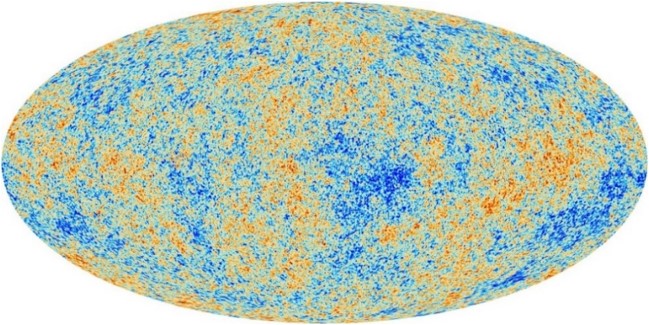
As well as all that amazing structure, those lacy archipelagos of warm and cool, the map showed a small and gradual variation in temperature from one end of the sky to the other, which was interpreted as a Doppler effect due to the satellite’s motion: the satellite is moving in that direction, with an effect that the sky is spectrum-shifted towards blue-hot because radiation energies in that direction are higher. The actual velocity worked out at about 600 kilometres per second, which was very surprising. A huge velocity like that (0.2% of the speed of light) had to include not just the satellite’s motion around the Earth, but also the entire relative motion of the Earth, Sun, the Milky Way galaxy and the local galaxy group, including all the orbiting elements of the sun around the galaxy and the galaxy within the group, and still left a very large speed of the local group seemingly going somewhere:

This mystery of directionally driven motion was never the main issue with the COBE data; scientists were and still are more interested in the grainy texture of the background, indicating the beginnings of structure in the early universe. It was our first evidence that the background was not perfectly uniform in every direction, there was a pattern in the early distribution of energy and matter, and overlying it almost incidentally there was this 600 km/s relative speed.
The better evidence now is a velocity of 368 km/s of the solar system in the direction of Leo. If you subtract the rotation of the milky way, the galaxy’s motion including that of the local group is closer to 630 km/s, while 368 km/s is the motion of our average observation point, in seemingly absolute terms relative to the CMB, yet we still don’t actually know why we are moving so fast. At the galactic scale, 630 km/s is well over six times faster than the average drift speed of galaxies such as ours. All the nearby galaxies might be in motion together by attraction to distant intergalactic superclusters, except that the densities of matter and distributions of other data are not in the right places to explain it. The poles do not align, in a technical sense that means exactly what it sounds like: a lopsided axis of energy that severely warps the standard model of the universe.
Whatever the speed, it was the observation itself that most surprised me, the idea that we could detect by any means a velocity relative to something so universal as the cosmic background. The CMB is everything, in a real sense. It is a frame that includes the entire cosmos in one snapshot, working as a complete point of reference which includes all possible points that we might ever want to refer to in any moment, all at once – every galaxy and everything in them, as they stood at the beginning of time.
So I had to ask, as many scientists did at the time: isn’t that a universal reference frame, by which we mean a very wrong and outdated old idea? It takes a while to get used to this but it’s completely true by Einstein’s relativity that there is no absolute state of rest or motion in the universe, so you can’t say for certain that we have some specific velocity relative to empty space: there is no such thing as an empty space of absolute zero velocity; that is, no universal reference frame, only our mundane individual relative motions. All those hot gassy clouds have no claim to be actually motionless even on average. They could all be in some coordinated motion towards and away from us, as though we ourselves are stationary at the centre of the universe. Fortunately there is a powerful principle due to Copernicus that this cannot be the case at any scale or place. There is no “stationary”, unless it is the action in a solution that will explain what we are seeing.
The CMB cannot be overestimated as a source of questions such as this. In a different reality of alien physics it’s possible that the background might be perfectly uniform, as smooth and featureless as a clear blue sky, but in this world, that’s not the case. Though almost perfectly uniform, in fact smoother than a billiard ball, it is a flickering furnace of radiation from the entire universe at its earliest stage of evolution, and even then the world is diverse and articulate. It is a pattern of such precision that the structures it reveals are filled with intelligible echoes, not an afterglow so much as a blaze of coded physical signals still burning in full view of our times.
This is all the more incredible as the gravitational process then had only just started forming the clumpy gaseous regions that later became galaxies, well before the stars were born. There was practically zero net motion in any direction, other than the random motion of hot particles in all directions. There is still today an overall uniformity of the distribution of matter, with no gravitational attractors sufficient to explain our apparent fall at high speed in one direction. There should be no significant local-to-general motion. So we have to ask, why that particular velocity? Especially one so far from any random small speed that could just be an approximate zero, the drift speed of galaxies due to only local forces.
The CMB is not a failure of relativity. It is not an absolute or even universal image but a relative and local one, our view of the microwave background radiation as seen from this vantage point. As with any forest of trees seen in the distance from different directions, Earth-based observers see events (such as particular thermalised gravitating regions) that align with our physical location and correlate the time-distance to such events. Regions with any significant persistence in time, say over the cooling period from around 4,000 to 3,000 Kelvin degrees during the recombination, the great cool spot for example, would appear similarly in all views of this observable CMB within similar horizons.
Extragalactic observers far from our local group would see a different mapping of the CMB, but only as different as a view in perspective from another time-place that is in relative motion. All observers within a given observable universe would see a time-varying image of a similar CMB, with no preferred direction but a persistence of the structures that can be seen. The flat image file can be re-imagined as a body in depth, a volume full of membranous mass-energy structures depicted in those tiny, slowly flickering fluctuations in temperature.
It’s a small step to realise, as I suddenly did, that the concept of visual perspective neatly resolves this crisis of relative cosmological spacetime. Our view of the CMB is like a four-dimensional star in action whose mapping we see partially from our location and state of motion. Other parts of the CMB, perhaps visible to observers in very distant galaxies, would be eclipsed to us, and the relativities along with the visible temperatures would be slightly different for everyone. This universe-scaled abstract impressionism has depths, hidden facets, and cross-sections through a distant but still-present time that we can see in a particular frame, the one we hang in our galleries.
But we’ve seen this before. There is a powerful confluence of principles, the laws of physics and the rules of perspective, that periodically engages art with science in history and reveals yet again that we are still learning this. As a young artist who later enroled in science, fascinated by physics, I saw the same geometric patterns as in a Renaissance landscape or cityscape. This is not a new idea, but one that became crucial to understanding the later Holographic Principle as an effect of scale and shape, a hologram at the edge of time, in the laws of geometry and even deeper Continuity Principle. The short preface above this history explains how this works in enough detail to begin with.
I had to wonder even then, long before holographic cosmologies first appeared in the literature, if perspective is a factor more generally in the theory of relativity. This turned out to make a lot of sense: the directions and distances that particular observers measure towards objects in motion, spacecraft or particles or objects of any kind, and the diminishment of their effects such as electromagnetic force and gravity, are the core ideas of special and general relativity. In the simple cases these reduce to trigonometric expressions, exactly the rules of non-linear perspective: natural to the eye and best analysed in more advanced cases with tensors, complex tables of directional values. This provides analytics that stem from comparisons of observer and observed, that we plot as mappings of multi-dimensional actions, as abstract as you might imagine General Relativity to be, but visible to the eye even if you don’t understand it.
In much the same way the linear perspective guidelines of Brunelleschi and others in the Renaissance are visual analytics of the space around an observer mapped onto the flat plane of a painting. This was a very late discovery in the history of art and architecture, and was revolutionary in its effects on human cognition of the world, perhaps even more so than relativity. At the end of the Middle Ages, when graphic art in perspective first appeared, whether we understood it or not we suddenly saw so much more in the world. Since that brilliant reawakening of human curiosity we have all grown up with easy 3D images of all kinds, and the only way to recapture the enlarged sensibility is to learn again how to draw in perspective. Not at the level of an exercise book (I wouldn’t ask you to work so hard!) but you might draw some diagrams.
As a science, perspective lacks only the dimension of time to capture motion, and a sense of scale in an expanding process dominated by light and everything else that behaves with the same perspective-like continuities, such as gravity and electromagnetic forces. When I added those, as a third year and later student, I found a plausible wave-particle model and a cosmology popping out of the different ways I could look at it in terms of perspective.
You have to understand that I was still pretty young, and doing a totally different course of study well outside of mainstream physics, let alone cosmology. I couldn’t take the idea very far. I saw what I’d done as a kind of wind-up toy in an interesting triangulating frame, and I didn’t think that it was particularly earth-shaking. For the next twenty-four years or so I thought about it occasionally, as a curiosity, and spent some time writing it out when I returned to finish my environmental engineering PhD, with what I also knew about quantum mechanics by then.
Struggling with particle physics as a kind of hobby it occurred to me that I was seeing perspective ideas recurring, and then when I started teaching physics I realised there were perspective-related physical laws at all levels, including the earliest foundations. This is of course no mystery in a science based on geometry built out in measurements around an observer. Hard-working physicists tend to make very little of the visual side of their science, for the practical reason that abstract concepts are powerful enough whether or not you have a diagram to scale, let alone in correct perspective, and they teach it that way so as to develop sharp minds.
As an artist, I went full visual with it. I have no regrets if my mind is the poorer for it, as I never wanted to be a theoretical physicist as such. I had a whole other artistic and practical career in mind. On the practical side, I used technical drawing techniques to dissect a 4D model of an expanding spherical cosmos on paper. I smuggled in what I now knew about dimensional analysis from fluid mechanics. I built in harmonics from the natural (i.e. physical) theory of music, and slowly but surely I came to see that it was giving the right answers.
This was all in loose notebooks, in no particular order after so many years, and I still had so much else to do before I could learn the language I would need to develop a cosmology. It was in my fifties that I finally had all the tools, contacts and time, so I sat down, doing the science and in particular, the maths. You can’t do physics without maths. It took me four years, with annual seminars, casual supervision and an international examiner. And I think it went as well as can be expected considering I was coming from a different academic planet, an environmental fluid mechanic making the leap to cosmology, where the stakes are very high.
I had essentially built an abstract soft clock based on the expansion of a gravity wave in 4D, a wave that carries a secondary radiation wave in 3D like a minute-hand in the surface of spacetime. This is light that is carried upon a process defined by gravity, moving at the same speed in an expansive motion of waves of heat and force at constant velocity as though radiated from a central star, the CMB. The combination of the two effects, constant outwards expansion and constant lateral radiation, in simple polar coordinates produces a logarithmic spiral; the ‘infinite line’ discovered by German Renaissance artist Albrecht Durer in 1525, then analysed by the master geometer René Descartes in 1638 and often known since those times as the marvellous or miraculous spiral:
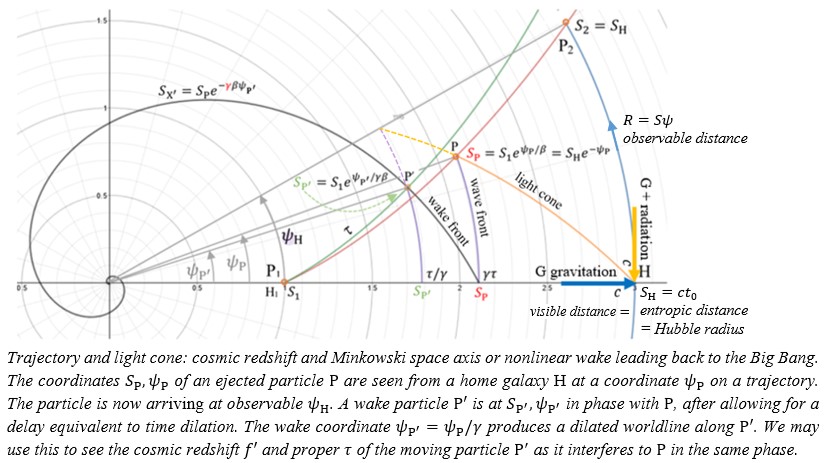
The spiral curvature of a nautilus shell is the archetype of this shape, for the natural reason that this surviving ancient cephalopod grows steadily in equal increments outwards and laterally around itself, adding new shell in both directions at every stage of its growth. The curve itself is of finite length, but extends macroscopically into a theoretically infinite number of turns, or angular coordinates. This useful adaptive pattern and its relatives recur in everything from vine tendrils to galaxies to black holes to bathtubs. The proper name for the involute polynomaly of the shape is the growth spiral. There’s a Desmos model from the Toy Universe of this analysis here.
Gravity, or rather geometry, expanding outwards as a nonlinear wave, and light or radiation radiating laterally around within the geometry at the same speed, follow a growth process with a constant light speed but decreasing light coordinate velocity, exactly a Hubble parameter of the finite age of the universe. In polar coordinates the outwards entropic radius (labelled with a capital S = ct) is the distance that light or gravity can travel in the age t of the universe, and the around-wards radiative distance is a co-moving ‘infinite’ coordinate ψ producing R = Sψ = ctψ that radiation passes at constant speed in 3D around the circumference, imagined as the volume of observable space. The nonlinearity of gravity produces a four-dimensional wake in the particle’s past, a delayed wave that interferes onto the observable wavefront near that time at the same phase, for example a particle and its dilated twins P’ and P, showing time dilation to correct scale.
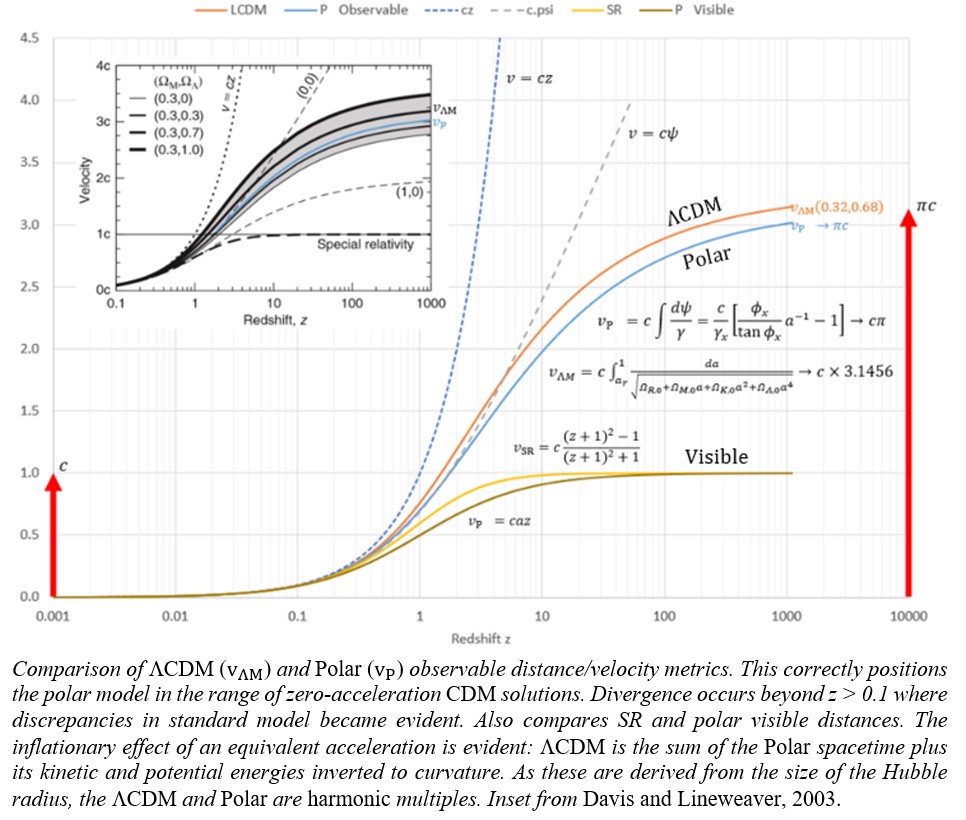
Certainly both marvellous and miraculous it seemed to me, because by following the contours of that spiralling universe, deep into time, I could extract a geometric solution that reduced the CMB dipole to a more manageable speed of 46 km/s. which is close to the expected drift speed of galaxies in our region of intergalactic space. How? Peculiar velocity on primary redshift dipole has an extra Doppler effect in the index of the scale factor, deriving that small correction from the curvature. You can solve it in a non-linear equation that might occur to you if you know these terms.
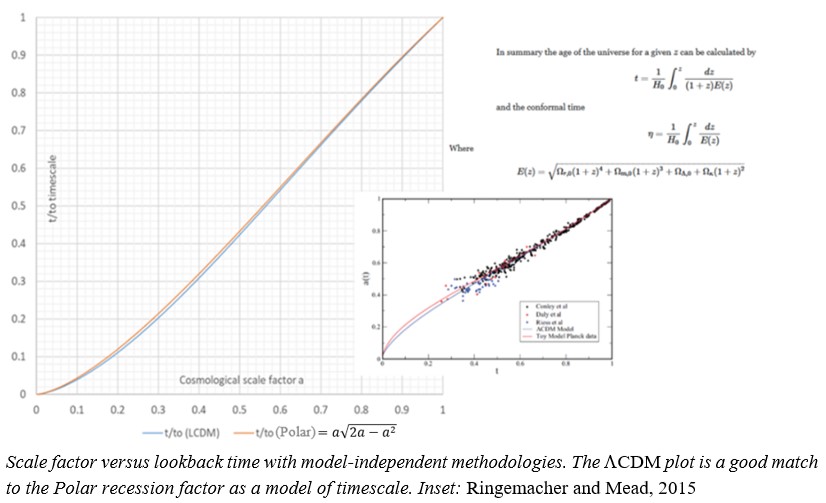
Not only that, but other solutions I could find by integrating and differentiating in various ways along the curvature kept coming within a hair’s breadth of the accepted though still controversial standard model, using the now very precise data of modern observational cosmology.
I found the right functional Hubble constant, and redshift in the form of a scale factor, that is the right colours of radiation for the size of the universe at those times. It had the correct general relativistic critical density, with graphs that fell right along the sinuous curves of the standard model. It even had the correct dark mass-equivalents, that is to say kinetic and potential energies that added up to the standard measurements of unknown dark energy and dark matter, as direct proportions of the total critical density in the observed spatially and energetically flat universe:
So I knew it was worth reading in one form or another, and I must admit I was totally dissatisfied with the academic style guide. The book evolved from an essay exploring holographic thought patterns as analogies to perspective views, with the geometric origins of those patterns taken seriously as physical laws that, like the laws of perspective, can be seen or imagined. The turning point came with a curved-spacetime cosmology and particle physics of the same laws; the effect being to see it all in perspective, often enough shocking even me. You can imagine my poor wife finding me clinging to the kitchen table over a pile of calculations, in vertigo as I suddenly saw the universe contract from infinite to finite towards me. “I can see it!” I whispered, in a moment that I have attempted to convey in less personal terms in the book.
The actual maths are visual ideas that you can experience for yourself when you get your head around them. This is no harder than first year university maths, which really just revisits the more advanced high-school subject, with radiating lines that point beyond that easy level. I admit this still sounds incredibly difficult, but I can promise you that I do know how to explain it. Relaxing away from technical language after so many years in the ivory tower has been a joyful process, genuinely leading to a incredibly enlightening global view that has to be conveyed in language of occasionally epic-mythical yet objective and sceptical proportions.
I wrote this as an artist with scientific background, carefully and at best gracefully avoiding the reductive risks of being too literal with the art or too dense with the science. It would serialise in a popular science and/or art magazine, but I aim higher: The readership is not just art, or science, but something that must be much larger as it also stems from music, which incredibly enough follows the same laws, the laws of continuity that underpin physics, art, music and the mind.
I walked from one end to the other of this big idea, setting out my own descriptions of quantum mechanics and relativity and all the rest of that amazing stuff, and in the process rediscovered my one great idea for what it is: a profound humanist cosmology, I am not too modest to admit, which makes a kind of strange sense and is actually a lot of fun to think about.
If you’re reading this you may well be looking at my blog, so welcome and feel free to have a look at the artwork, music and other writings as well.
I once explained to a friend, as a child I had two of the great old Time-Life books, The Universe and The Mind, and I’m still trying to read and understand them. This book, like The Tao of Physics by Fritjof Capra or almost anything by Paul Davies, tries to explain these mysteries in terms that highlight the paradox and yet allow a deeper way of relating to it: Capra by his eastern parallels, Davies through the sheer clarity of his explanation, and in my case by an idea of the limitations of human perspective, that can be re-imagined to see the mind of a creative universe and to hear, as the source of all energy, the enormous voice of a dynamic space-time.
***
Suggested “Spectrum” weekend magazine-style blurb: half synopsis, half author bio
Science, music and art are the historical drivers of culture, too often treated as separate ideas in a world of academic hierarchies. This book goes some way to find their common elements in modern cosmology, a field of real and imaginary horizons, impasto particle landscapes and accidental portraits of the human condition. Taking you through this strange reality in a series of powerful visualisations, games and hypotheticals, M Gaelen Evans is a scientific generalist, multi-media artist and obscure poet-musician mining a sensation and realisation as much Cézanne as Einstein, in a bold attempt to see and hear the universe in natural perspective and audible harmonics. Combining aesthetics, mechanics, relativity and the holographic horizons of astrophysics and neuroscience, The Vanishing Skylines of Quantum Cosmology is an exhilarating/terrifying ride to the limits of knowledge and the edge of spacetime as a visible and musical landscape – a view into the tangible and intangible universe, embedded in a world of many possible futures that ultimately co-exist in our minds. With insights into the role of artificial intelligence and a playable “toy” universe model looking into both past and future, this book is a fascinating new take on modern science that places the reader at the centre of their own senses.
***
Peer-reviewed Theoretical Research Papers I – IV:
***
Original essay: Cosmology (2003 – With all the raw elements of the eventual 2026 book)
…
Appendix 1 (1992 – Obvious juvenilia, but a useful record of how long I have been working on this – witness the clumsy student all-caps handwriting, and all my early mistakes).
***
Relativity from Scratch (2012 – my first draft of a set of relativistic and astrophysical derivations for private study and the remotest possibility of a job teaching those subjects)
***
***
* From “an otherwise not unusually peculiar childhood“: This book is in many ways an homage to childhood, so when I tell the story without that part, people often want to know what happened to me, and then say that’s the best part:
This long idea and the resulting book are the end result of a train of thought spanning most of my life, in alternating stages that I understood first in visual art, then as science, then back again over many cycles. You could call this the journey of a mildly poetic child whose early instincts for musically pigmented light and atmospheric effects were never eclipsed by an interest in physics.
To someone trying to live in the real world, art is more usually a frustration than a useful talent. Nevertheless it carried me along with the profound and almost constant inspiration of my early moments, the idea I had in childhood, a geometric idea I had of infinity with continuity of large and small. This had to do with the shape of a bathroom nautilus shell and the edge of the universe, which I could see expanding in the bathtub if I stared into it for long enough. I knew the bath could inflate without limit and come to a crisis. I had seen it shimmer with standing wave vibrations like a beehive of tiny ripples. Slowing it down revealed fine details in the meniscus at the rim, which sucked out curliques of soap like distant spiral galaxies, forming a ring like a horizon.
This was all I needed to get me started on a very long creative and intellectual journey. The spiral puzzle stayed in my mind with the art, and I never lost it. Have you ever tried to work out the geometry of a bathroom shell? I was that kind of peculiar child. I followed the Taoist tai-chi of Yin and Yang, in lost juvenile eras of landscape, portraiture, cubism, the blue four; working in pens, oils, dyes, glass, broken mirrors; seeking weird perspective effects in corners, attempting astral travel and finding it only slightly harder than talking to girls. In the same life I struggled through several early careers and periods of homelessness aiming for my own choice of uni enrolment.
The multiple flaws in a creative-for-its-own sake approach to a scientific idea should be obvious. The fuzziness of art, the freedoms of expression and abstraction, seem to be inventions not discoveries. Yet it’s true that the principles of continuity, balance, harmony, perspective, laws which we discovered from geometry, are the same laws of physics emerging as effects that diminish with distance and deflect away at an angle. Art is a Science, or so it seemed to me; in fact it’s all science, by a broader definition that I had to discover one alternating step at a time.
For much of my childhood and youth the process was a tough weekly decision between art box and chemistry set, multimeter and guitar, with often strange results. My journey, having chosen four different fields, became four times longer. Then at last in early adulthood by intense study on what seemed almost exactly the same page as recent artwork I noticed something odd about a new satellite dataset, something unusually peculiar in a technical sense, which by that stage I thought I knew should not be possible, needing explanations that I felt I could almost see…
…
Brief Literature Review and Comparisons
Popular physics is fun, deep, surprising and verifiable. The best books in the genre aim for a blend of factual science with implications that carry you along amazed.
The book’s themes are Cosmology: e.g Katie Mack’s The End of Everything, a light-hearted-terrifying roller-coaster review of the many possible deaths of a universe; Quantum Mechanics: Sean Carroll in Something Deeply Hidden leads the field for depth of subject matter and his own contributions, and is also a lot of fun; and Special and General Relativity: Carlo Rovelli’s The Order of Time is a very surprising re-examination of the most elusive dimension, and the most well-established evidence in the genre; with an excursion into Holographic Mind Science: for a recent biophysical neuroscience with the depth needed for cosmology, see Robert Wiles’ The Mind in the Matrix.
To come anywhere near the sense of humour, profundity, detail, and freshness of ideas in these books, and many others in physics and related philosophy of science, is to write a great new book:
Katie Mack, 2020. The End of Everything (Astrophysically Speaking). Scribner. ISBN 198210354X
Sean M. Carroll, 2019. Something Deeply Hidden: Quantum Worlds and the Emergence of Spacetime. Dutton. ISBN 978-1524743017
Carlo Rovelli, 2017. The Order of Time. Penguin Books (English Edition). ISBN 9780241292525
with
Robert Wiles, 2019. The Mind in the Matrix: What the Complexity of the Universe tells us about Meaning. Information Press (Australasia) PO Box 159 Cooma 2630 NSW.
…
Similar and complementary titles include the entire recent bibliography of popular science/physics and neurophysics books, such as:
Heinrich Päs, 2024. The One; How an ancient idea holds the future of physics. Icon Books. ISBN 9781837730308
Matt Strassler, 2024. Waves in an Impossible Sea; How everyday life emerges from the cosmic ocean. Basic Books, SBN-13 9781541603295
Giorgio Parisi, 2023. In a Flight of Starlings; The Wonders of Complex Systems. Penguin. ISBN 059349315X
Sean Carroll, 2022. The Biggest Ideas in the Universe; space, time and motion. Dutton. ISBN 978-0593186589
Robert Wiles, 2019. The Mind in the Matrix: What the Complexity of the Universe tells us about Meaning. Information Press (Australasia) PO Box 159 Cooma 2630 NSW.
Anil Ananthaswamy, 2018. Through Two Doors at Once: The Elegant Experiment that Captures the Enigma of Our Quantum Reality. Dutton. ISBN 1101986093
Sabine Hossenfelder, 2018. Lost in Math: How Beauty Leads Physics Astray. Basic Civitas. ISBN-10 0465094252
Lawrence M Krauss, 2017. The Greatest Story Ever Told – So Far: Why Are We Here? Atria Books. ISBN 978-1-4767-7761-0
Frank Wilczek, 2016. A Beautiful Question: Finding Nature’s Deep Design. Penguin Press. ISBN 9780718199463
Noson Yanofsky, 2016. The Outer Limits of Reason: What Science, Mathematics, and Logic Cannot Tell Us. MIT Press ISBN 026252984X
Jeremy Griffith, 2016. Freedom: The End of the Human Condition. WTM Publishing and Communications. ISBN-10 1741290287
Christophe Galfard, 2015. The Universe In Your Hand; A Trip Through Space, Time and Beyond. Macmillan. ISBN 978-1-4472-8408-6
Pedro G. Ferreira, 2014. The Perfect Theory: A Century of Geniuses and the Battle Over General Relativity. Little, Brown. ISBN 978-1-4087-0310-6
John D. Barrow, 2013. The Book of Universes – Exploring the Limits of the Cosmos. W.W. Norton & Company. ISBN 0393343111
Lawrence M. Krauss, 2013. A Universe from Nothing: Why There Is Something Rather Than Nothing. Simon and Schuster. ISBN 1451624468
Patricia Churchland, 2013. Touching a Nerve: The Self as Brain. Norton agency titles. ISBN 0393058328
Steven Strogatz, 2012. The Joy of x: A guided tour of mathematics from one to infinity. Atlantic Books, London. ISBN 978 1 84887 845 7
Daniel Bor, 2012. The Ravenous Brain: How the New Science of Consciousness Explains Our Insatiable Search for Meaning. Basic Books. ISBN 046502047X
Sean Carroll, 2009. From Eternity to Here: The Quest for the Ultimate Theory of Time. Dutton. ISBN 978-0525951339
Paul Davies and John Gribbin, 2007. The Matter Myth: Dramatic Discoveries That Challenge Our Understanding of Physical Reality. Simon and Schuster. ISBN-13 978-0743290913
Julian Barbour, 1999. The End of Time: The Next Revolution in Our Understanding of the Universe. Oxford University Press. ISBN 0-7538-1020-4
Edward O. Wilson, 1998. Consilience: The Unity of Knowledge. Random House. ISBN 9780679450771
John C. Eccles, 1994. How the Self Controls Its Brain. Springer-Verlag. ISBN 3-540-56290-7
Ian Stewart, 1989. Does God Play Dice? The New Mathematics of Chaos. Penguin Books. ISBN 978-0-631-23251-3
Stephen Hawking, 1988. A Brief History of Time: From the Big Bang to Black Holes. Bantam Dell. ISBN 978-0-553-10953-5
Richard P. Feynman, 1988. QED: The Strange Theory of Light and Matter. Princeton University Press. ISBN 0691024170
James Gleick, 1987. Chaos: Making a New Science. Viking Books. ISBN 0-7493-8606-1Richard Dawkins, 1986. The Blind Watchmaker: Why the Evidence of Evolution Reveals a Universe without Design. Norton & Company Inc. ISBN 0-393-31570-3
John C. Briggs and F. David Peat, 1986. Looking Glass Universe: The Emerging Science of Wholeness. Simon and Schuster. ISBN 0671632159
Paul Davies, 1985. Superforce: The Search for a Grand Unified Theory of Nature. Simon and Schuster, Touchstone Books. ISBN 0671605739
Lewis Carroll Epstein, 1983. Relativity Visualised. Insight Press, ISBN 0-935218-03-3
Paul Davies, 1982. The Accidental Universe. Cambridge University Press. ISBN 0521242126
Douglas R. Hofstadter, 1979. Gödel, Escher, Bach: an Eternal Golden Braid. Basic Books. ISBN 978-0-465-02656-2
Gary Zukav, 1979. The Dancing Wu Li Masters. William Morrow. ISBN 0-688-03402-0
Fritjof Capra, 1975. The Tao of Physics: An Exploration of the Parallels Between Modern Physics and Eastern Mysticism. Shambala Publications. ISBN 978-0704501423
Steven Weinberg, 1977. The First Three Minutes: Modern View of the Origin of the Universe. Basic Books. ISBN 0465024351
Erwin Schrodinger, 1958. Mind and Matter. Cambridge University Press. DOI: https://doi.org/10.1017/CBO9781139644129
Erwin Schrodinger, 1944. What is Life? The Physical Aspect of the Living Cell. Cambridge University Press. ISBN 0-521-42708-8…
…
…
…
…
…
…
…
…
…
…
…
…
…
(these long rows of ellipses serve to push all random advertising material well to the bottom of each page)

